
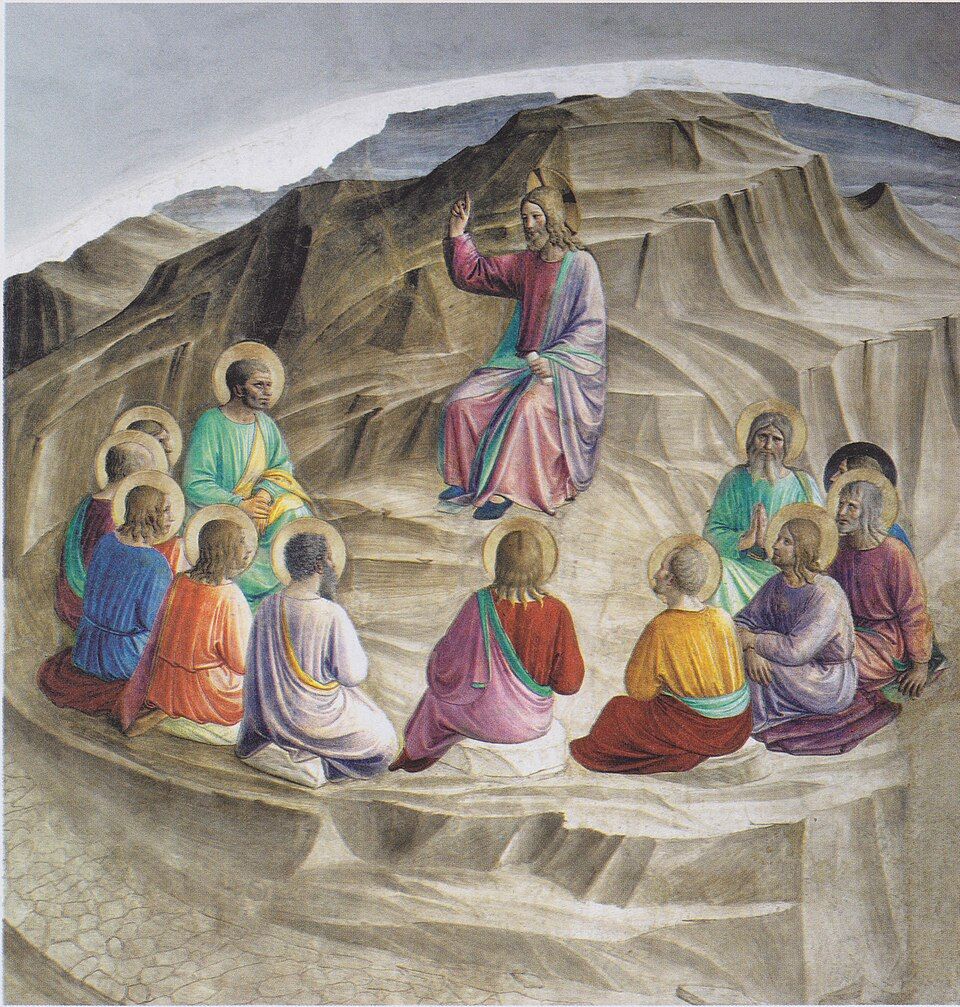
The Beatitudes are Jesus' first teaching in the Gospel of St Matthew. They are how he chooses to start his Sermon on the Mount. Therefore, they are of particular significance; words he wished to give us from the beginning of his ministry. This Lent we could let them inspire, challenge, and form us. Over the next four weeks, we shall explore each of the eight Beatitudes on Fisher House's website.
We can note that the Beatitudes, in general, have been interpreted in three different ways: as descriptions of people's present situation; as rules for the life of the Church; as ethical exhortations. Without dismissing the first two ways, it is the third interpretative approach which was the most common in the Early Church and has been since. Therefore, we shall explore the Beatitudes as Jesus' exhortation to us regarding the way we should live. 'Should' because they contain the promise of blessedness or everlasting happiness. This is why St Gregory of Nyssa describes the Beatitudes as the means to journey to the top of the mountain.
Let's start where our Lord began: 'Blessed are the poor in spirit, for theirs is the kingdom of heaven' (5.3). πτωχός is the Greek Matthew uses for 'poor.' It is the strongest available Greek word for social poverty. The attention Our Lord gives to the poor in the Gospels, in a time when they were dismissed, shows us that poverty is not a sign of God's disfavour. In fact, we shall be judged for how we care for the poor (cf. Matthew 25.25.31-46).
But this Beatitude is not first about material poverty but poverty in spirit. The Biblical scholar, Theodor Zahn, who was thrice nominated for the Nobel Prize for Literature, wrote that the 'poor in spirit' are 'those who in regard to their inner lives stand before God as beggars...with the feeling of their inability to help themselves.' Zahn shows us why Jesus places this Beatitude first. It teaches us the fundamental openness and expectation which we need so to be able to receive all the others teachings and examples Jesus will give us.
This letting go and living as we are truly are - children of God - is humility. Such humility is not weakness but wisdom. It is when we really comprehend our situation: that all that is good in our life, including life itself, is God's gift. Our sins are our responsibility but, if we live in 'poverty in spirit' by placing God at the centre of our lives and leaning upon him completely, they need not control us.
Jesus himself is the greatest model of such humility. Though the Son of God, he entered fully into the human condition. As St Gregory of Nyssa wrote, 'For your sakes he became poor.'
We shall not, however, completely spiritualise this Beatitude. We each know how material things can get a hold on us. We confuse our self worth with what we own and make idols of our belongings. Yet, Jesus allowed himself to be stripped naked on the cross for our sake. How then can we say that I need this label or brand?
This Lent what shall we let go of so that we may be poor in spirit?


