
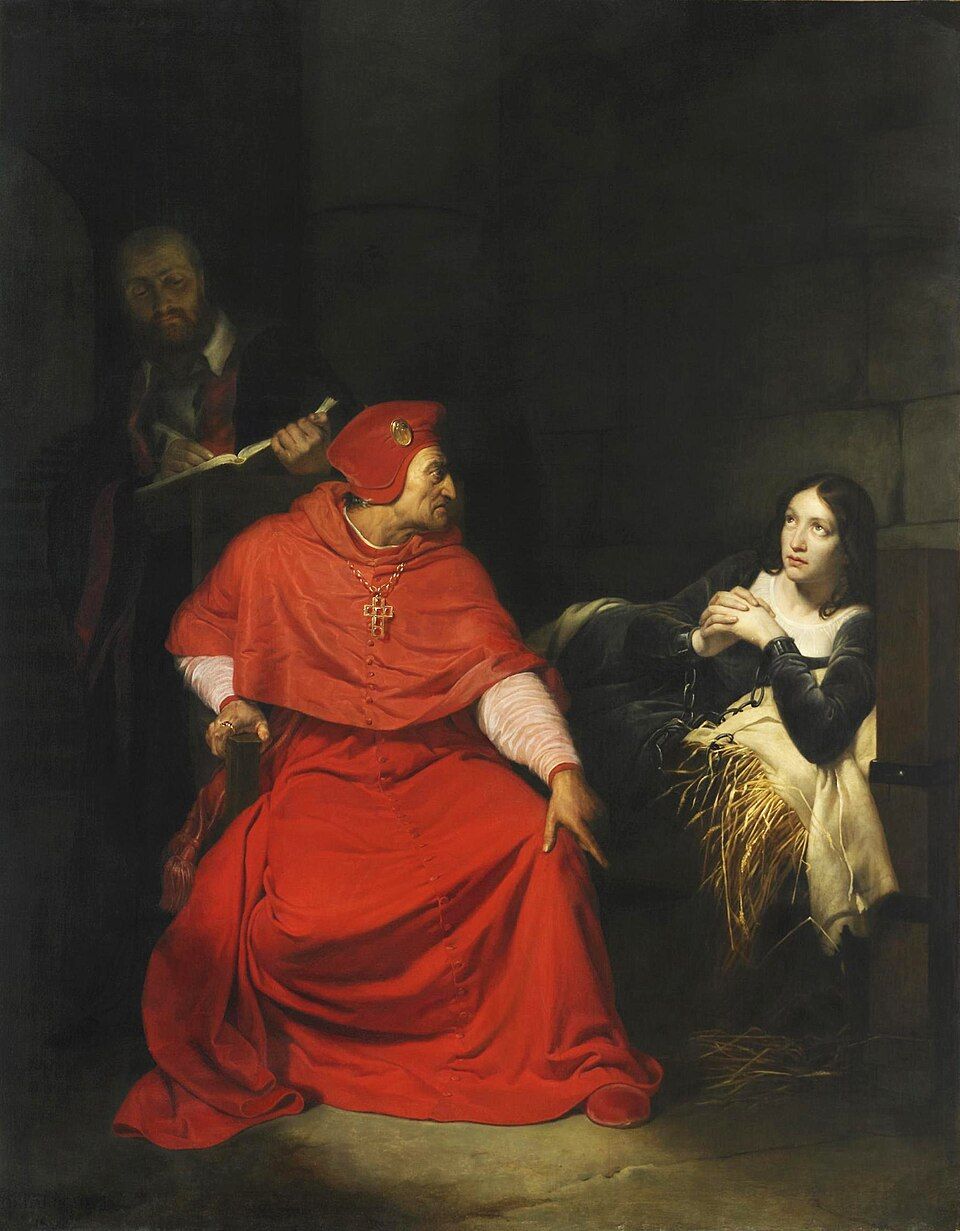
In 1824, the French painter Paul Delaroche recreated on canvas the moment the English prelate Henry Beaufort interrogated St Joan of Arc in prison. The priest’s infamy had already been established by Shakespeare in his plays concerning Henry VI. However, such a scene never happened. What is true is that six hundred years ago, in 1426, Beaufort was the first member of Cambridge University to be made a cardinal. Whether he was worthy to be raised to the purple, others can decide, but it suited a man who for all his life was at the centre of English and European politics.
How did Henry Beaufort become so significant? First, he was the son of John of Gaunt, a son of Edward III of England. Born around 1375, Henry was the second of John’s four illegitimate children with his mistress Katherine Swynford. It seems he was destined for the Church from the start and was sent to Peterhouse in 1388. He would reside at Cambridge’s oldest college for one year before moving to Queen’s College, Oxford. By 1396, John of Gaunt was a widower and married Henry’s mother. Soon after their children were legitimised by both papal bull and royal charter. A year later, in his early twenties, Henry was made Bishop of Lincoln. At the time, his cousin, Richard II, was king. However, in 1399, Henry Bolingbroke, the eldest son of John of Gaunt, deposed Richard, and seized the crown. For the rest of his life, Beaufort served kings of England who were successively his half brother (Henry IV), his nephew (Henry V), and his great-nephew (Henry VI).
Henry’s closeness to the throne partially explains his significance. However, he was also an astute politician, often called to serve and able to survive every attempt to diminish him. He presided at Henry IV’s marriage to Joan of Navarre, for two years was his chancellor of England, and was always a member of the king’s council. He became once more chancellor for Henry V and it was Beaufort who announced in St Paul’s cathedral the news of the king’s victory at Agincourt, which his uncle described as proof of English invincibility. By the end of Henry V’s reign, he was out of favour, but when the monarch died prematurely, leaving a child, Henry VI, to ascend to the throne, Beaufort became a powerful presence on the royal council, which now acted in loco regis. There were moments of glory, such as when, in Paris, he crowned his great-nephew King of France. But generally, these were tough years as those close to the weak king fought to dominate.
However, what made Beaufort so powerful was not only his royalty and political usefulness, but his immense wealth. In 1404, Henry IV had had him moved from the Diocese of Lincoln to Winchester, the richest see in the country. This combined with the money he accrued through many other civil and ecclesiastical offices, the export of wool, and legacies from Henry IV, made Beaufort the wealthiest English prelate of the late middle ages. This allowed him to bankroll three successive monarchs, who were always in need of money, especially because of fighting in France.
In the midst of all of this, Beaufort was raised to the purple. He was first named a cardinal by Martin V in 1417. The pope had been elected at the Council of Constance (1414-1418). This had been summoned to deal with several problems, including the embarrassment of the Western Schism, by the end of which three men claimed to be the rightful successor to St Peter. Beaufort was at the council as part of the English delegation and supported Martin V’s candidacy. In gratitude, the new pope not only named Beaufort a cardinal but also legate a latere, which allowed him to act in the pope’s name in England. Henry V was furious. He did not want another power in the land. He did not allow his uncle to become a cardinal and made various threats against him. It was only during the reign of his great-nephew that Beaufort was finally able to accept the cardinalate at a ceremony in Calais.
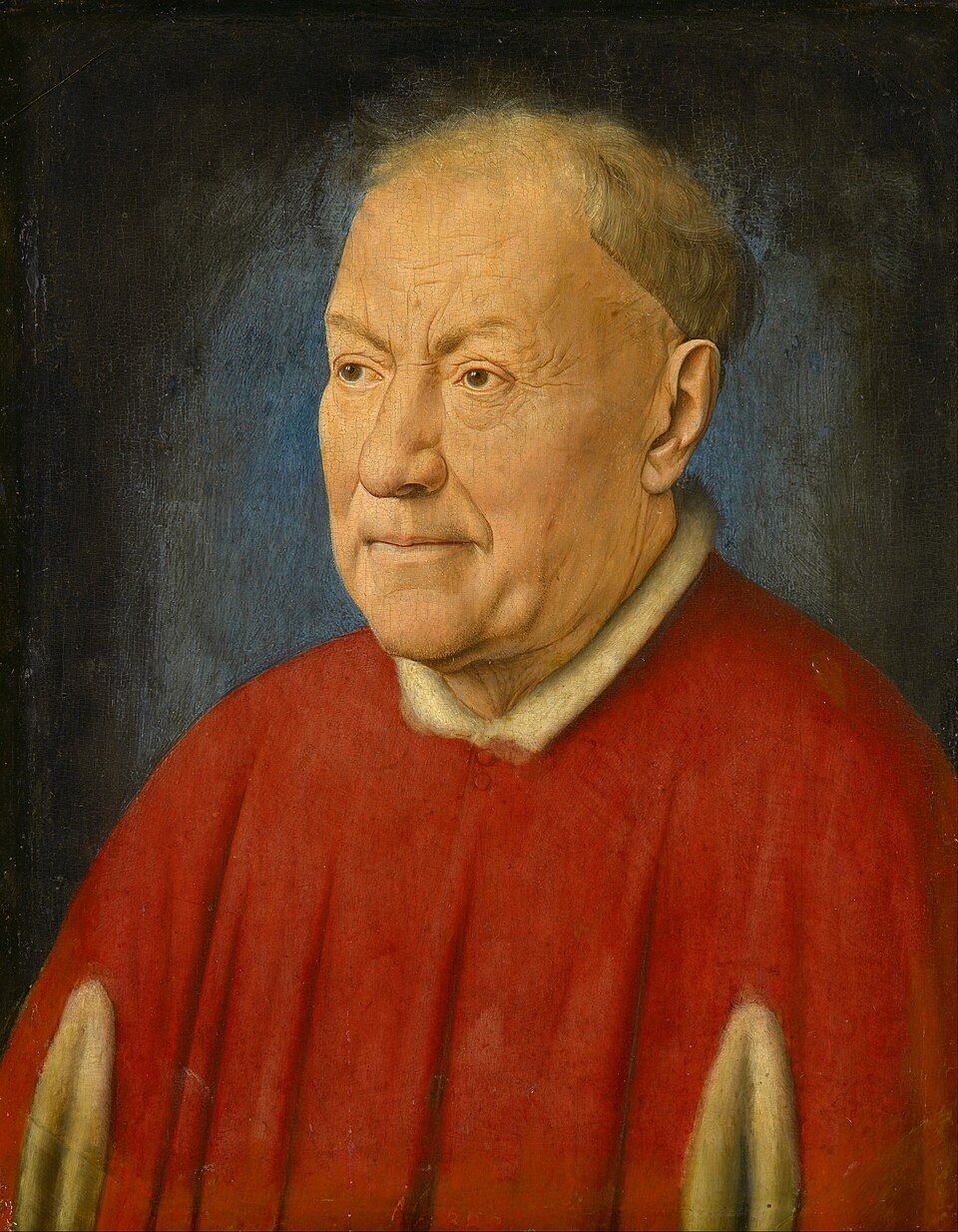
Now styled by himself as the Cardinal of England, and by others as the Rich Cardinal, he would live for another twenty-one years; notable by the end not only for his political career but for his fifty years as a bishop. He died at Winchester in 1447, where his splendid tomb can still be seen. Hundreds of years later, Delaroche would do him a disservice. There is no evidence that he interrogated St Joan, though he presided at her trial and burning. However, it may be possible to see him accurately. It was long thought that the portrait by van Eyck in the Kunsthistorisches Museum in Vienna was of Cardinal Niccolò Albergati. However, many scholars now argue that it depicts Henry Beaufort. If so, it is the earliest realistic portrait of any Englishman. It allows us to meet Cambridge’s first cardinal.
This Friday (13 November) at 6 pm in Peterhouse Chapel, Holy Mass will be celebrated to mark the sexcentenary of Henry Beaufort becoming a cardinal. All are welcome.


