After studying at St Mary's College, Oscott, Fr Tenny Anthony was ordained for the Archdiocese of Birmingham on Friday 10 July at St Chad's Cathedral during a Syro-Malabar Liturgy. The next day, he celebrated in thanksgiving a Votive Mass of Christ, the High Priest. Fr Paul had the privilege of preaching at the Mass. As we prepare to celebrate Revd Jack Ryan's ordination, we share the homily so we can begin to think of Fr Jack's life as a priest. The first reading at Fr Tenny's Thanksgiving Mass was taken from the Letter to the Hebrews (10.11-18).
Every priest stands daily at his service, offering repeatedly the same sacrifices, which can never take away sins. But when Christ had offered for all time a single sacrifice for sins, he sat down at the right hand of God, then to wait until his enemies should be made a stool for his feet. For by a single offering he has perfected for all time those who are sanctified. And the Holy Spirit also bears witness to us; for after saying, ‘This is the covenant that I will make with them after those days, says the Lord: I will put my laws on their hearts, and write them on their minds,’ then he adds, ‘I will remember their sins and their misdeeds no more.’ Where there is forgiveness of these, there is no longer any offering for sin.
St Augustine went to Milan to teach rhetoric. He was not yet a Christian. Indeed, he was prejudiced against Christianity. However, he sought out the Bishop of Milan, St Ambrose, because he knew Ambrose was a famous orator. In his spiritual autobiography, The Confessions, Augustine tells us what happened next. He writes:
‘The man of God received me as a father and welcomed me with the true kindness of a bishop, and I began to be greatly drawn to him, at first not as a teacher of the truth, for which I cherished no hope at all in the Church, but as a man who showed kindness towards me’ (13.23).
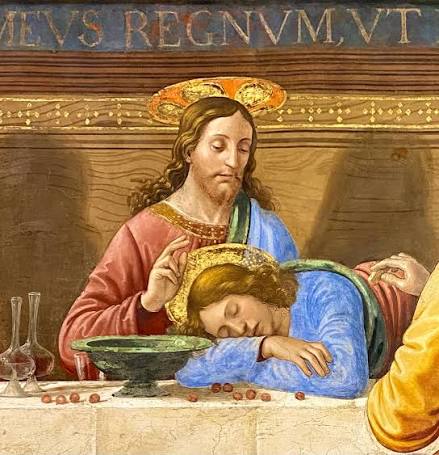
In our reading from the Letter to the Hebrews, the writer of the epistle contrasted the old Levitical priesthood with Christ’s priesthood. And what stands out is that Christ does not stand. We were told of the old Jewish priesthood that ‘every priest stands daily at his service, offering repeatedly the same sacrifices, which can never take away sins. But when Christ had offered for all time a single sacrifice for sins, he sat down at the right hand of God.’ Christ, the High Priest, does not have to stand because there’s nothing more to do. He has saved us, once and for all. He can sit down. And so can you, Fr Tenny. Now that you share completely in Christ’s priesthood, you too can sit down - to hear Confessions, consoling God’s People with the Good News that Christ’s sacrifice has saved them. And when giving absolution you will declare what we also heard in the reading from Hebrews, words of God first spoken to the Prophet Jeremiah: ‘I will remember their sins and their misdeeds no more.’ In a world where nothing is forgiven or forgotten, you will bring, Fr Tenny, God’s loving forgiveness and gracious forgetfulness.
There’s another reason why our newly ordained priest should sit down. Because there’s too much rushing around. We need more priests to do God’s work. But even when there were many priests, it was a temptation for them to find their meaning and self-worth in busyness. It is the disease of functionalism. Too often priests will judge how well they are doing by the number of appointments in the diary, by how many committees they have been asked to join, by their popularity as a guest speaker. But Fr Tenny, what you will do as a priest, is not what makes you a priest. Instead, you know the Scholastic maxim, agere sequitur esse - action follows being. It’s who you are that matters. And through your priestly ordination yesterday, you are now irrevocably, ontologically, in your deepest being, a priest of Jesus Christ, the Head and Shepherd of the Church. What we need first is not what you will do but who you are: Christ among us. Often, the first thing parishioners say to their priests is, ‘I know you’re busy, Father.’ We are. But we can do nothing better than to be present to our people; they are our busyness. We must strive to be organised and good preachers but neither Ambrose’s administrative abilities nor oratory began Augustine’s conversion. It was his presence and kindness.
When I have had difficulties, mostly self-inflicted, the greatest consolation has been the privilege of celebrating Mass; being with Christ both as the celebrant and by receiving His precious body and blood. The priest’s daily celebration of the Holy Eucharist can be the antidote to functionalism because it reminds us that anything we do is only worthwhile if it flows from our communion with the Lord. Intimacy with Jesus is what transforms the lived experience of priesthood from a job to an act of love. And, as St Augustine said, ‘Whatever is hard in what is demanded of us, love makes easy.’ Fr Tenny, allow yourself to commune daily with the Lord. Don’t allow the all-too easy, stupid, and self-defeating thought that you are too busy to pray. In her Treatise of Discretion, St Catherine of Siena pictures God’s love as a fountain. She says, ‘If a man carries away the vessel which he has filled at the fountain and then drinks of it, the vessel becomes empty, but if he keeps the vessel standing in the fountain, while he drinks, it always remains full.’ May we all, but especially our priests, continually sit and drink at the fountain of God’s love.
Christ no longer stands but sits because, as we heard in Hebrews, ‘By a single offering he has perfected for all time those who are sanctified.' How do we experience this perfection? The writer of Hebrews tells us. By God the Father fulfilling his promise: ‘I will put my laws on their hearts, and write them on their minds.’ That is, we now know, within us, how we should live. We have the capacity to be what Christ is: obedient. Such obedience is the other antidote to functionalism. Writing on priesthood, the future Pope Benedict XVI said this:
‘It is important that the ontological union with Christ abide in the conscience and in action: all that I do, I am doing in communion with Him. By doing it, I am with Him. All my activities, no matter how varied and often externally divergent, constitute only one vocation: to be together with Christ acting as an instrument in communion with him.’
Such communion with Christ, such obedience, is frightening. What happens if he asks us to do something we don’t want to do? It will be hard but because it is of God, it will also be the best thing for us. And, to repeat St Augustine, ‘Whatever is hard in what is demanded of us, love makes easy.’
Fr Tenny, we are so proud of you. We are so grateful to God that you are our priest. And we hope one thing for you, which, selfishly, will be the greatest blessing for us, that you will be truly, madly, deeply in love with Christ, who now, for ever, you are for us.


