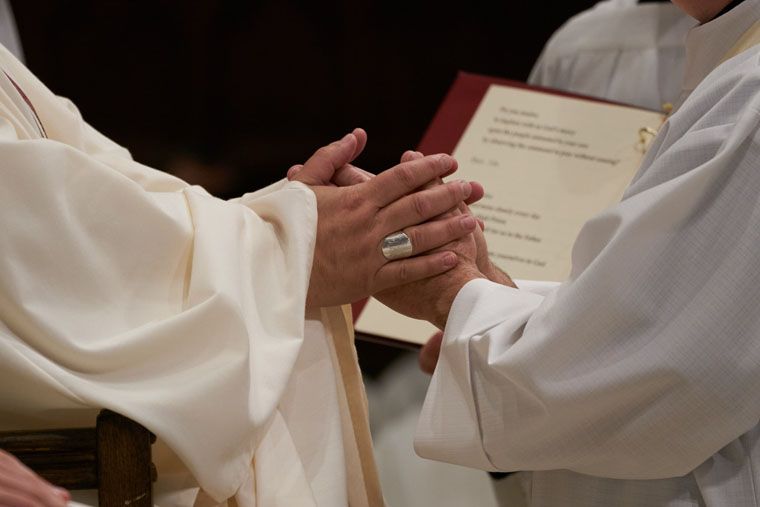
Graduands are graduating. They are filing into the Senate House and, unless they choose otherwise, they each kneel before the Vice Chancellor (or deputy) and place their hands, with palms pressed together, between the hands of this officer of the University, who then says to them:
Auctoritate mihi commissa admitto te ad gradum (name of degree), in nomine Patris, et Filii, et Spiritus Sancti - 'By the authority committed to me, I admit you to the degree of [name of degree] in the name of the Father, and of the Son, and of the Holy Spirit.'
The new graduate then rises, bows to the Vice-Chancellor, and exits through the Doctor's door of the Senate-House to receive their degree certificate. Despite all the pomp surrounding the ceremony, for each new graduate it was a brief moment. And now the next stage of their life has begun!
I am particularly conscious of this year’s ceremony because it is the thirtieth anniversary of my own graduation. In that year, John Major was the Prime Minister, Bill Clinton was the President, and Dolly the sheep was the first mammal to be cloned from an adult cell. But I am also struck by this: in three weeks’ time, Revd Jack Ryan will go through a similar ceremony. At his ordination to the priesthood in Portsmouth Cathedral, he too will kneel to place his joined hands between another’s but, this time, his bishop’s. But why (particularly, as Jack has already done this once before!)?
The gesture is a feudal one. As a vassal would once place himself at the service of his Lord, so too, before his priestly ordination, a man promises both respect and obedience to his bishop, repeating what he had already promised when he was ordained a deacon. However, the significance of the gesture is far from feudal. A vassal did not share in his Lord’s responsibilities; he was purely an instrument to serve his Master’s will. But a deacon’s or priest’s promise of obedience involves a willingness to share in the mission of his bishop. And when the bishop looks down at the man kneeling before him, he hopes that this young man will continue to minister long after he is dead.
The newly ordained is not a vassal but a co-worker for the bishop, his father in Christ. This is why the promise at both ordinations consists of respect and obedience. Obedience by itself would fall short of what is needed. Without, first, respect, the deacon or priest may do what is asked of him but opposition and bitterness could begin to breed in his heart. Respect ensures that not only is the bishop obeyed but that his requests are embraced.
Back to the graduands. Quite a few of them now decline to kneel and graduate in the name of the Blessed Trinity. They eschew such traditions. But a Christian recognises that whatever they have been studying at Cambridge, it is not alien from God. Instead, our degrees are only possible because of our Creator and everything we do that is worthy – including growing in understanding and wisdom – is to the glory of God.


