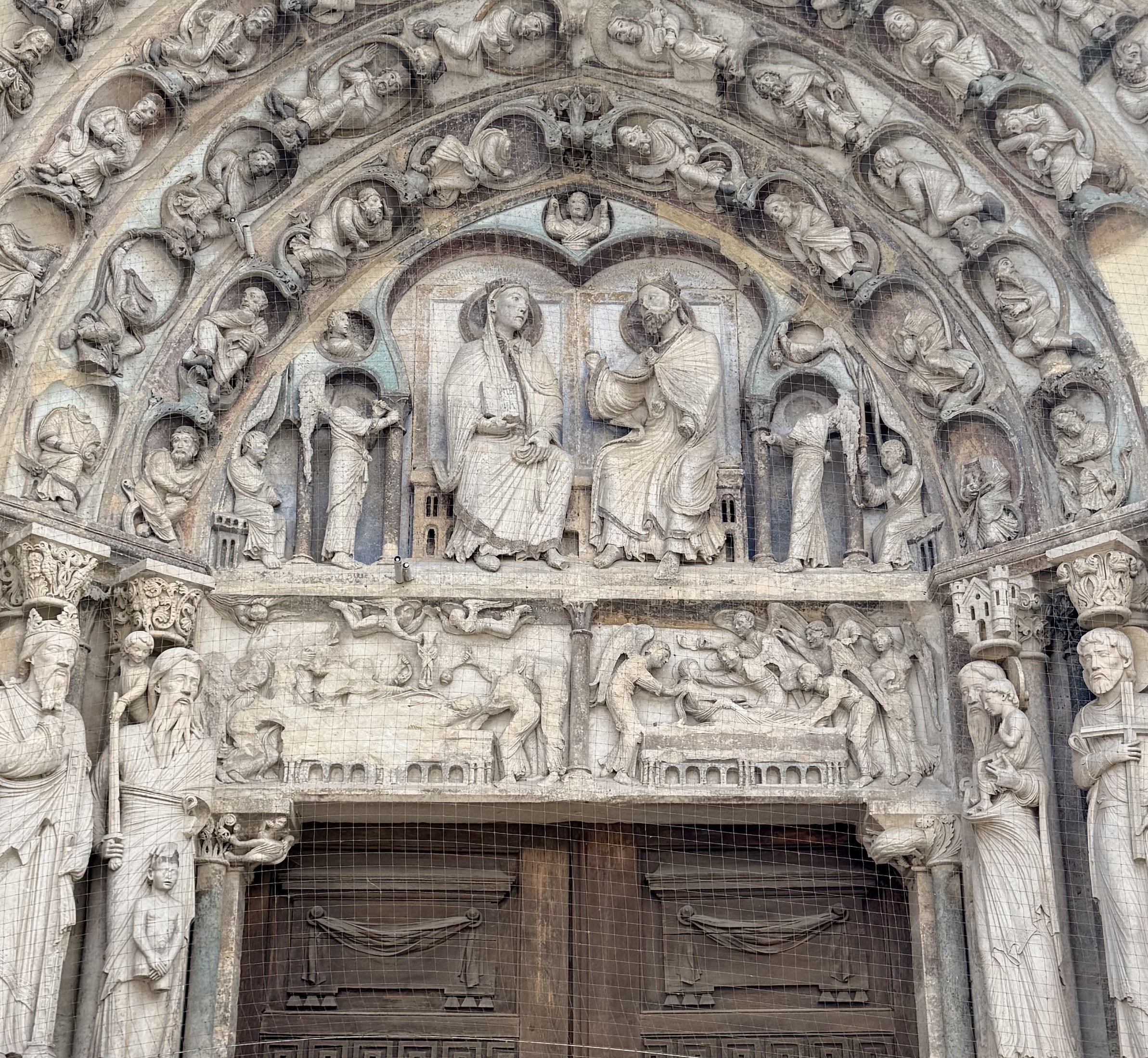
In the Hauts-de-France, only one hour’s drive from Paris, in the town of Senlis, is perhaps the earliest surviving sculpted depiction of the Assumption of the Blessed Virgin Mary. It is above the west door of the former cathedral and dates from the twelfth century. That Mary had been assumed into heaven – soul and body – at her death was already well established in Christian thought; it was a liturgical feast by the fifth century. But how the assumption should be depicted had not yet settled. Therefore, as I did in person a few weeks ago, it is fascinating to look at the lintel and tympanum of Senlis.
On the bottom left, Mary’s body is shown, with perhaps a funeral shroud around it, being lowered into a tomb by the apostles, two of whom wave thuribles. Meanwhile, Mary’s soul rises to heaven, greeted by angels. On the bottom right, with wonderful overlapping movement, angels appear to carry Mary’s body to heaven. One angel begins to raise the body out of the tomb by pushing up the shoulders. It is a scene busy with tenderness. However, most space is not given to Mary’s two-fold assumption. Instead, what is most prominent is the depiction of the assumed Mary, sitting beside her son and Our Lord. Both are enthroned and crowned, each looking to the other.
The former Octave of the Assumption was removed during the liturgical reforms of Pope St Paul VI. However, at the same time, Pope Paul moved the Feast of the Queenship of Our Lady from 31 May to 22 August and so, today, we still have a type of octave. That our Lady is Queen of Heaven was only formally taught by Pope Pius XII in 1954. However, the west door of Senlis shows that Mary’s queenship was already recognised eight hundred years before. As St John Henry Newman wrote, ‘If the Creator comes on earth in the form of a servant and a creature, why may not His Mother, on the other hand, rise to be the Queen of heaven, and be clothed with the sun, and have the moon under her feet?’
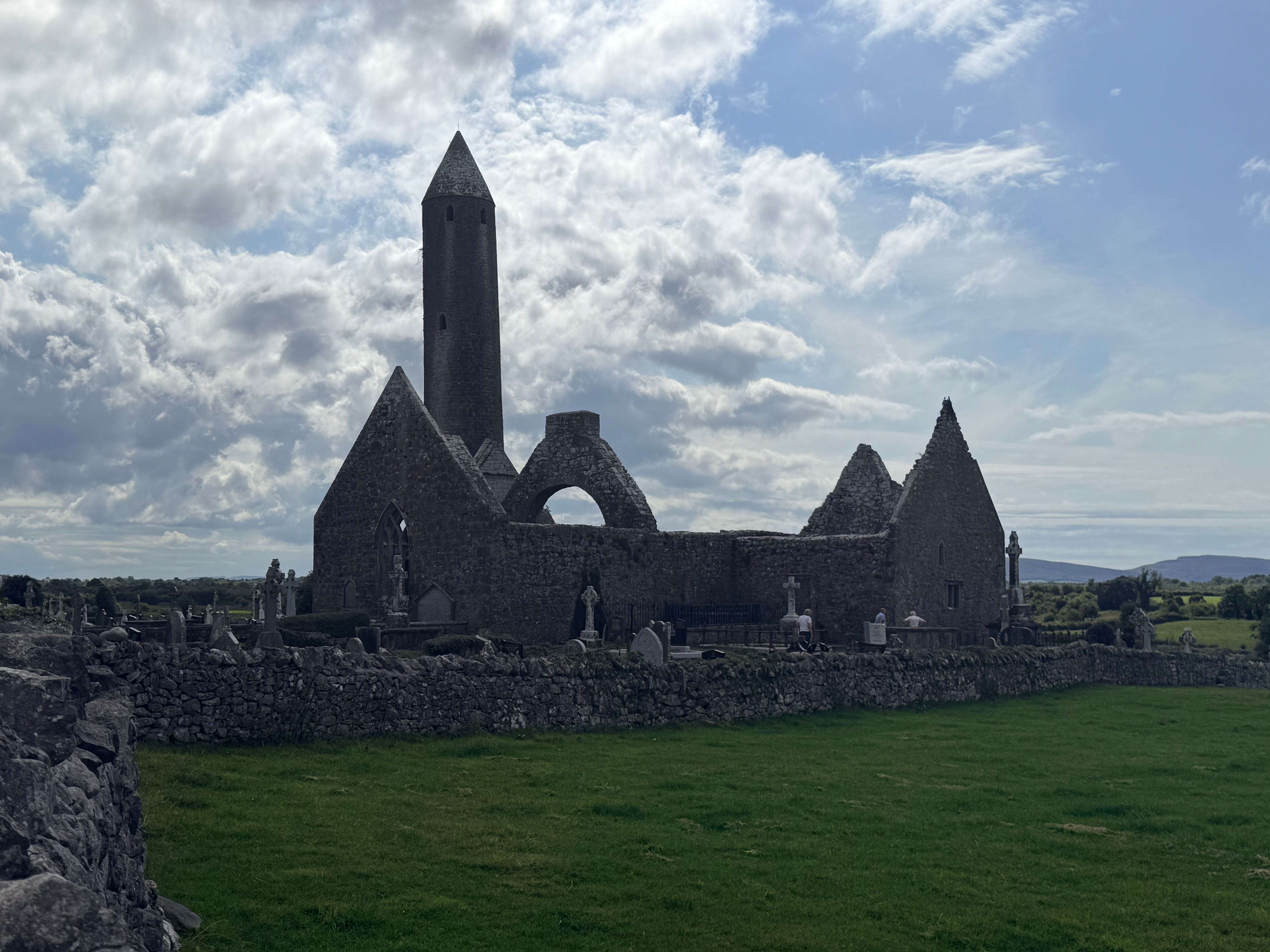
I write this piece on the south side of Galway Bay. Seven miles away are the ruins of the monastic complex of Kilmacduagh. The round tower, the tallest surviving in Ireland, looks over a landscape of limestone and turloughs. The monastery was founded by St Colman in the seventh century. The location was chosen for him. He was seeking a suitable place for his community when, on this spot, his girdle slipped off. He saw in this a sign and so settled. This makes me think of Our Lady’s girdle. There is a medieval tradition that as St Thomas the Apostle had doubted Our Lord’s resurrection, so he doubted Mary’s assumption. Therefore, having been assumed, she returned to Thomas and left her girdle with him; physical proof of her bodily departure. Both St Colman and Our Lady sought to do God’s will but in Mary’s case, her obedience became a cause for our salvation. It is fitting, therefore, that she should share immediately in her son’s resurrection.
As we celebrate the Assumption, our celebrations need not be confined to the solemnity. Instead, let’s keep celebrating until and including 22 August because Mary’s Queenship is the natural corollary of her assumption. Mary’s assumption is not only a promise that we too shall rise but also that Our Lady intercedes for us in heaven beside her Son. Adrienne von Speyer says it well:
‘Adam and Eve form a pair; but Eve comes after Adam. Yet she is of equal birth to him, and she commits sin together with him. Christ and Mary also form a pair; but Mary comes to the world before her Son. She is not of equal birth to him, insofar as he is God from eternity, nor does she think in terms of equality, but rather of service. When, however, the Son elevates her so that despite everything they form a pair in the same way that Christ as Bridegroom and the Church as bride form a pair, the Mother lets this happen in the knowledge that everything he does is done well.'


